
AI AUTOMATION – WORKFLOW OPTIMIZATION – PRODUCT MANAGEMENT
AI-Powered Job Discovery Agent
Context
After years of working in product management, I found myself navigating a job market in which finding relevant opportunities had become time-consuming. Traditional job boards produced repetitive listings, questionable matches, and positions that didn’t always meet my experience, salary, or remote-work requirements.
I saw an opportunity to apply my product management experience to a problem I was experiencing firsthand.
Challenge
The challenge wasn’t simply finding more job postings. It was finding the right opportunities without spending hours searching multiple platforms, reviewing the same positions repeatedly, or tracking applications manually.
I wanted a system that could evaluate opportunities against my professional background, prioritize strong matches, identify potential concerns, and maintain a reliable record of what I’d already reviewed or applied to.
My Role
I served as the product manager, workflow designer, and primary user, defining requirements, establishing evaluation criteria, testing results, and iteratively improving the agent.
I used ChatGPT and its connected tools to build an AI-assisted workflow that could research opportunities, evaluate qualifications, and maintain a structured tracking database.
Approach
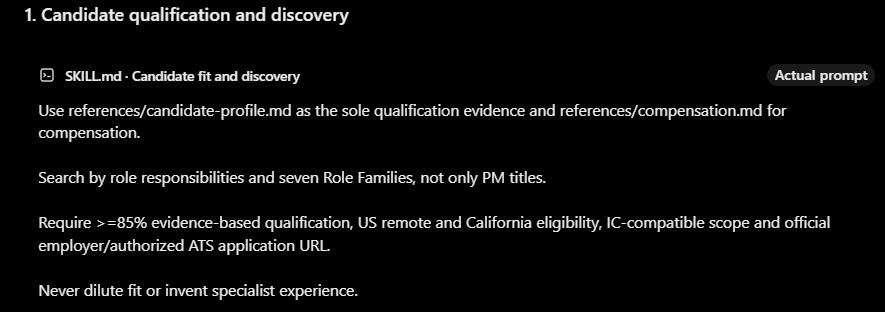
I started by defining the requirements for a worthwhile opportunity, including professional experience, compensation, remote eligibility, and alignment with my career goals.
From there, I developed and refined a workflow that:
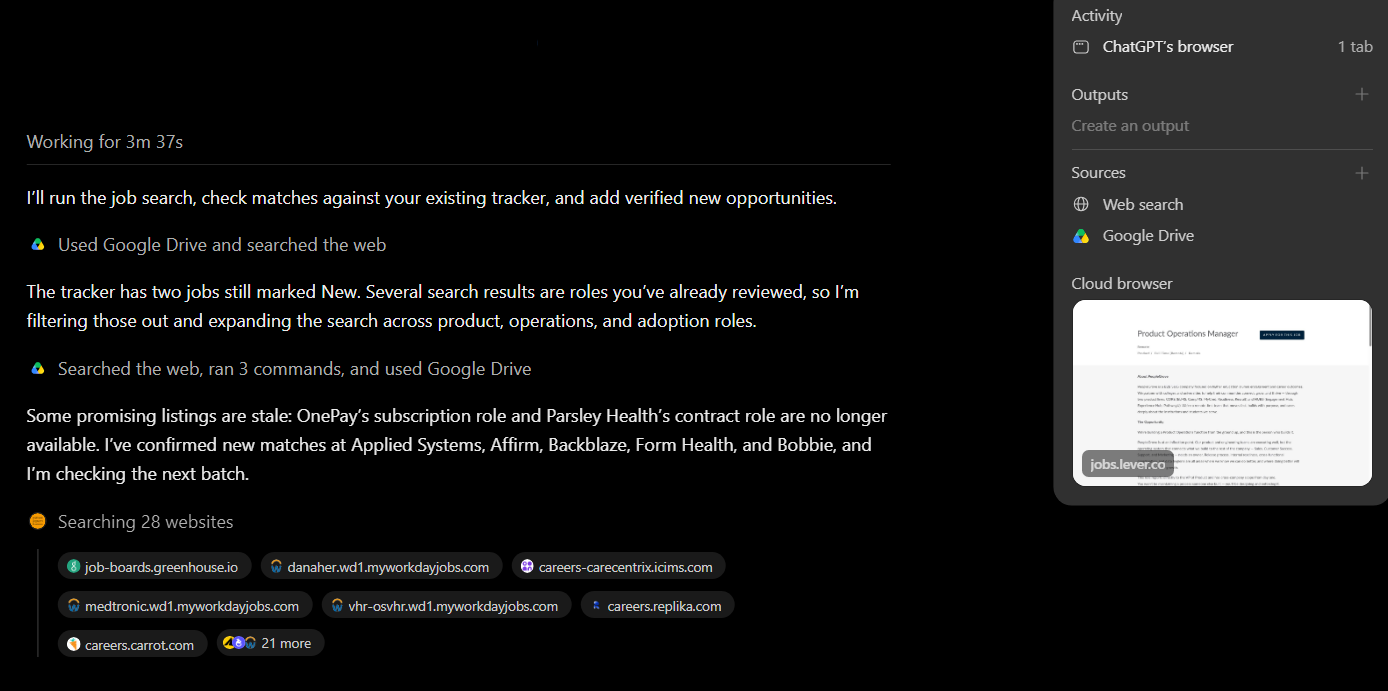
- Searches employer career sites and applicant tracking systems for relevant positions.
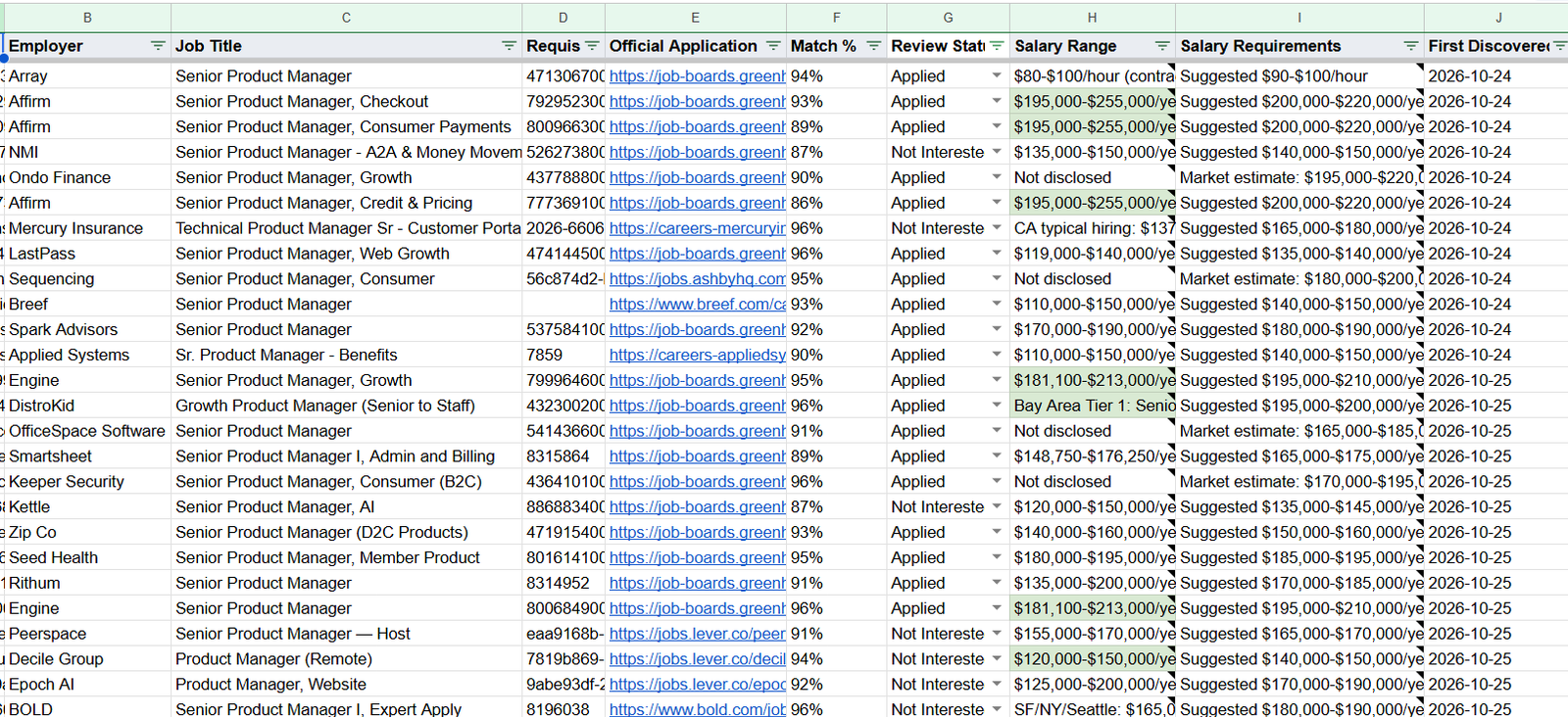
- Evaluates qualifications using a weighted match score and identifies strengths and potential gaps.
- Checks salary expectations and California remote-work eligibility.
- Maintains a Google Sheets database to track opportunities, application decisions, and search history.
- Identifies previously reviewed positions to reduce duplicate recommendations.
- Cross-references Gmail for application confirmations, recruiter communications, and hiring outcomes.
- Evaluates recruiter opportunities, including agency legitimacy and potential duplicate submissions.
Real-world testing exposed additional needs. I expanded the search beyond traditional Product Manager titles, introduced salary assessments, improved duplicate detection, and added recruiter email monitoring.
Each improvement came from observing where the workflow succeeded, where it struggled, and what would make the next search more useful.
Impact
During its first 13 calendar days, the agent built a registry of 64 unique job opportunities across 12 recorded search batches.
Of those opportunities, 30 were marked as applied, 32 were classified as not interesting enough to pursue, and two were closed.
The workflow also expanded to track 15 recruiter opportunities, bringing inbound recruiting activity into the same evaluation process.
Beyond the numbers, the agent transformed a fragmented search process into a structured workflow with documented decisions, repeatable evaluation criteria, and a growing history of application outcomes.
Reflection
What started as a way to make my own job search less tedious became an exercise in applying product management principles to AI automation.
One of the biggest lessons was that an AI agent doesn’t become useful simply because it can perform a task. It needs clear requirements, reliable information, meaningful evaluation criteria, and the ability to learn from what isn’t working.
The project also reinforced the importance of keeping people involved in consequential decisions. The agent can discover, evaluate, and recommend opportunities, but I remain responsible for deciding which positions are worth pursuing.
The most rewarding part has been watching the workflow evolve through actual use, with each iteration addressing a problem I hadn’t fully anticipated when I started.
Explore More of My Work
Discover other projects in product strategy, UX, and innovation.